
The Evolution of American Football Uniforms
Post Views: 2,190 The American football uniforms has transformed from a basic set of “work…
The American football uniforms has transformed from a basic set of “work clothes” into a multi-billion dollar segment of aerospace-grade sports engineering. This evolution isn’t just about fashion; it is a direct response to the increasing speed, power, and medical understanding of the game for Evolution of American football uniforms.
1. The “Canvas & Leather” Era (1880s – 1930s)
In the early days of gridiron, “protection” was an afterthought.
- The Fabric: Players wore heavy, quilted cotton or wool sweaters. Players often sewed leather patches onto their elbows and knees to evade tackles.
- The “Smock” Jersey: In the late 1890s, the “Princeton Smock” dominated the gridiron—a canvas jacket that repelled opponents with its slippery surface.
- In fact, helmets were not mandatory in the sport until 1943. Previously, many players chose to compete with only leather caps or no headgear at all. Early versions were simple “soft-shell” leather caps that offered zero concussion protection.
2. The Synthetic Revolution (1940s – 1970s)
Post-WWII technology introduced plastics and synthetic fibers that changed the game’s weight and safety.
- Plastic Helmets: In 1939, John T. Riddell introduced the first plastic helmet. By the 1950s, these featured internal suspension systems to absorb shock.
- Nylon & Durene: Durene (a mix of cotton and rayon) and later Nylon supplanted heavy wool as the industry standard. These fabrics were lighter but still retained significant moisture (sweat), making players heavier as the game progressed.
- The Facemask: The single-bar facemask appeared in the 1950s, finally protecting the player’s face from direct impact.
3. The “Speed & Stretch” Era (1980s – 2010s) for Evolution of American football uniforms
As the sport became a televised spectacle, “looking fast” became as important as “being fast.”
- Spandex & Compression: The 1990s saw the rise of Lycra/Spandex blends. Coaches realized that a tight-fitting jersey made a player harder to tackle.
- During this era, manufacturers adopted ‘porthole’ mesh to facilitate cooling. Specifically, they used large holes to move air, even though these gaps significantly reduced the fabric’s durability.
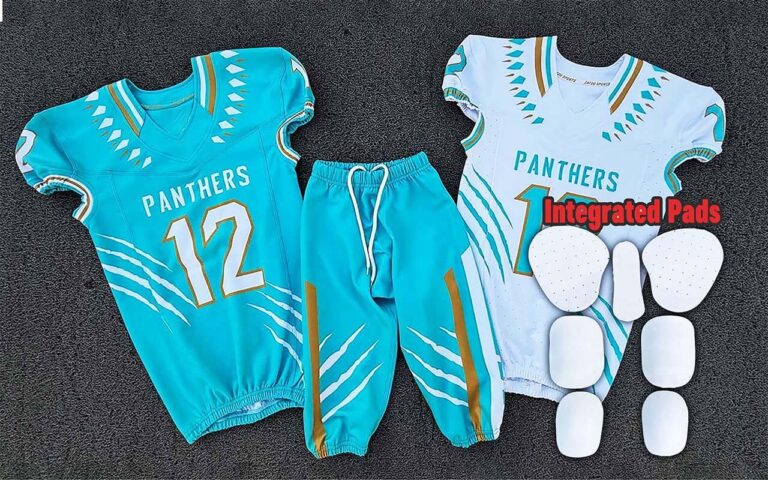
- Poly-Plate Padding: Thin, hard-shell plastic plates supplanted massive foam pads, dispersing energy more efficiently without the added bulk.
4. The 2026 High-Tech Standard: Intelligence & Precision
Today, the uniform is a piece of integrated technology.
- Zonal Thermal Mapping: 2026 uniforms use laser-cut perforation and “Aero-Mesh” in high-heat zones (armpits and lower back) to regulate core temperature via a chimney effect.
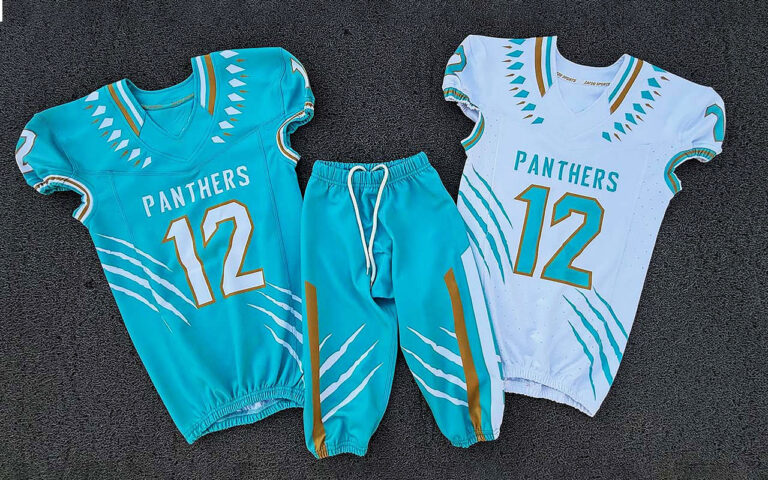
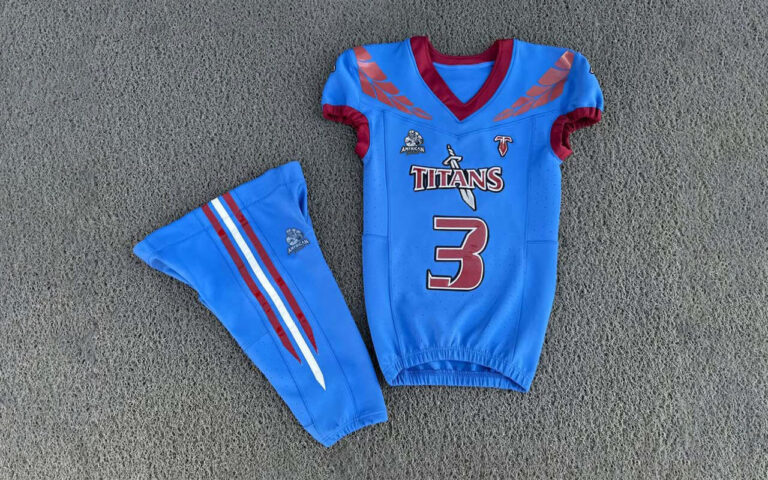
- Sublimation Printing: Gone are the days of heavy, cracking screen-print numbers. Full-Digital Sublimation fuses ink into the fibers, allowing for 90s-inspired “Retro” designs and complex gradients without adding a single gram of weight.
- Smart Integrated Gear: Elite 2026 uniforms feature integrated pockets for GPS and Impact Sensors, allowing training staff to monitor a player’s G-force exposure and heart rate in real-time.
Historical Comparison: Then vs. Now
| Feature | 1926 Standard | 2026 Professional Grade |
| Primary Material | Heavy Wool / Canvas | Recycled 4-Way Stretch Polyester |
| Helmet Material | Soft Leather Cap | Polycarbonate with Liquid-Shock Liners |
| Jersey Weight (Wet) | ~5 – 7 lbs | < 1 lb (Moisture-wicking) |
| Graphics | Sewn Felt Patches | Digital Sublimation (Zero-weight) |
| Fit | Loose / Boxy | Ergonomic “Anti-Grab” Compression |
The Future of the Kit
The evolution of the American football uniform reflects a sport that has moved from a campus pastime to a professional science. As we look toward the 2030s, expect to see “Self-Healing” fabrics and uniforms that change color based on the player’s biometric health, ensuring the gridiron remains the pinnacle of sports innovation.
FAQs for blog “The Evolution of American Football Uniforms”
American football uniforms have evolved from heavy wool and leather gear to lightweight, high-tech performance apparel. As a result, modern uniforms improve speed, safety, and overall player comfort.
Helmets became mandatory in 1943. Before that, players often used leather caps or no headgear, which offered very limited protection against serious injuries.
Modern football uniforms use advanced polyester blends with 4-way stretch and moisture-wicking properties. In addition, manufacturers use lightweight materials that enhance durability and player mobility.
Technology has introduced features like zonal ventilation, sublimation printing, and impact sensors. Consequently, players benefit from better temperature control, lighter gear, and real-time performance tracking.
Future football uniforms may include smart fabrics, biometric tracking, and self-healing materials. Therefore, uniforms will continue to enhance safety, performance, and innovation in the sport.